Cognitive Redistribution, Not Cognitive Decline
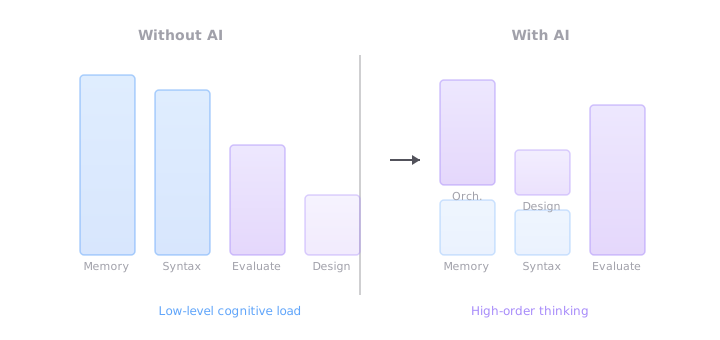
    ┌──────────────────────┐          ┌──────────────────────┐
    │     LOW-LEVEL        │          │    HIGHER-ORDER      │
    │                      │          │                      │
    │  ██ memory           │          │  ▓▓ evaluate         │
    │  ██ syntax           │   ═══>   │  ▓▓ design           │
    │  ██ computation      │          │  ▓▓ orchestrate      │
    │                      │          │                      │
    │  (offloaded)         │          │  (amplified)         │
    └──────────────────────┘          └──────────────────────┘

    Cognitive load shifts. It doesn't disappear.
A few months ago, I started seeing the headlines everywhere. "ChatGPT Is Rotting Your Brain." "AI Makes You Dumber." Study after study, shared breathlessly, all pointing to the same conclusion: AI chatbots are causing cognitive decline.
I immediately knew it was misguided. Not because the data was fake, but because I've seen this before -- with writing, with calculators, with search engines. Every advancement that helps humans direct cognitive effort toward different challenges always looks like loss at first. At least, to those not paying attention.
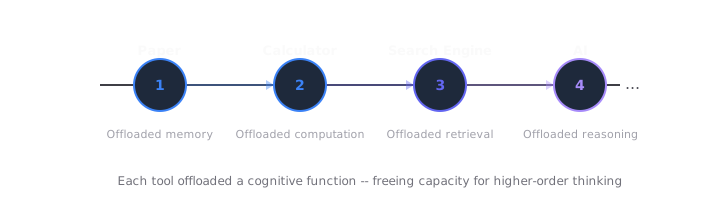
Once upon a time, people thought paper would be the end of civilization. On the surface, it would seem that way -- paper allowed humans to store so much knowledge that they no longer had to hold memory palaces filled to the brim with stories and facts. From some perspectives, this could look like we lost an important skill. But in reality, we made room for more advanced processes when we offloaded like that.
What's happening now with AI isn't new. It's the same pattern playing out for the dozenth time.
What the Studies Actually Found
Four studies are driving this narrative, and I want to be fair to them. The findings are real.
The MIT EEG study showed brain activation drops during AI-assisted writing. The Microsoft/CMU survey of 319 knowledge workers found that higher trust in AI correlated with less critical thinking. Gerlich's study of 666 participants found strong correlations between offloading and lower critical thinking scores. And Dergaa's AICICA framework proposed "AI Chatbot-Induced Cognitive Atrophy" as a concept worth investigating.
The Microsoft/CMU study is actually the most interesting one to me -- 319 knowledge workers, 936 real-world examples of generative AI use. That's real data from real people doing real work. But even then, I'm cautious when reading research. The framing of the paper and the motivations of the authors can bias the results. And in this case, the same data that showed less critical thinking also showed people shifting from execution to stewardship -- a description that sounds a lot more like redistribution than decline.
The Three Problems With Calling This "Decline"
The methodological problems here are serious.
First, correlation does not equal causation. The Gerlich study found a strong correlation between AI use and lower critical thinking. But a large portion of the cohort were youths, who already struggle with critical thinking. I'm willing to bet introducing almost any kind of technology to the same group would yield similar effects. You can't rule out that people with lower critical thinking skills are simply more drawn to AI tools, rather than AI tools causing the decline.
Second, the brain conserving energy during offloaded tasks is a feature, not a bug. The human brain is truly an efficient machine -- it requires an enormous amount of energy to power a human being, and it's constantly regulating that energy across a network of organs and functions. It looks for shortcuts all the time. When it finds one that works, it uses it. Much like a pilot uses autopilot to give their brain and body a rest, AI allows for the same relief across domains. Lower EEG activation during AI-assisted tasks isn't evidence of damage -- it's exactly what a healthy, efficient brain should do.
Third, none of these studies are longitudinal. A longitudinal study would show actual decline -- or lack thereof -- because it would look at cognitive capabilities across the same benchmarks over time, accounting for the many other factors that could contribute to cognitive changes. You can't claim "decline" from a single snapshot.
The Alternative: Cognitive Redistribution
So if it's not decline, what is it?
The same thing it's always been. We offload what we no longer need to carry, and we redirect our energy toward higher-order work.
This is no different from when we allow our trust in the correct mathematical answer to be given to us by a calculator. Can we do the arithmetic? Sure. We're capable. But it requires concentration and energy that we may not wish to spend. So we offload that to a device. Search engines do the same thing -- they allow us to not have to dig through encyclopedias to find the right answer. The capacity didn't vanish. It was redirected.
I experience this directly in my own work. I use AI to code a lot. I'm offloading both the labor of writing code and the memory burden of proper syntax. But I am still the architect of the business logic. I am still the evaluator ensuring outputs are precise. The thinking comes from orchestration and systems design -- the kind of thinking that sits above the code itself.
AI has also helped me cross domains between development and data science. Coding was already a bridge between those worlds, but the logic that drives a production workflow and the need for statistical regression tests on thousands of website features -- that's where AI helps make a connection that would have taken years of specialization to build on my own.
Where the Concern Is Actually Legitimate
I'm not saying AI use is always benign. There are real risks, and I want to be honest about them.
Many people are on the passive side of AI use -- accepting outputs uncritically, letting the tool think for them rather than with them. This doesn't worry me in the sense that it's new; people were already passive with other technologies. Tech innovation, in all its forms, can be abused this way, and often will be. But the question worth asking isn't "does AI cause decline?" -- it's "under what conditions does AI use lead to growth versus passivity?"
The genuinely new risk AI poses is its ability to simulate understanding. This is the biggest problem, because it's exacerbating the already large problem of misinformation. It's hard enough combatting purposeful misinformation from bad actors, but to have that compounded by accidental misinformation from LLM hallucination is an issue worth looking at much deeper. A student who asks ChatGPT to explain a historical event and receives a fluent, convincing response may walk away feeling like they understand it -- when what they actually have is just a memory of reading something convincing.
How We'd Actually Test This
If someone handed me the funding to run the study I've proposed -- a two-battery longitudinal design measuring both decline-sensitive and redistribution-sensitive variables over 12 months -- I know which result would excite me most.
Evaluation calibration. I'd genuinely love to see humans grow their ability to think about their own thinking because of AI. That's metacognitive growth -- not just thinking better, but understanding when you're thinking well and when you're not.
I'd be surprised if we didn't see better error detection too. I think we're already witnessing it. People are getting a lot better at spotting AI-generated images and videos designed to fool them. The evaluative muscle is developing, even if no one's measuring it yet.
The orchestration measure is significant for a different reason -- the skill literally didn't exist before AI. And this is the entire point of external artifacts. They aid in human evolution by allowing our brains to focus on novel challenges and new ways to tackle them. If we ignore these entirely new skills, we ignore what is actually helping us grow and evolve.
The Takeaway
The adage "everything in moderation" is true now and always has been. Technology will always be both a danger and a salvation to humankind.
If you are dedicated to growth -- growth of knowledge, growth of character, growth of experience -- then you will benefit greatly from how technology can help your mind grow. Those of us committed to the pursuit of learning will utilize any advantage we can get, and AI is a big one.
Most people are probably evaporating their freed cognitive capacity rather than reinvesting it. That's not surprising -- most tech innovations end up going this way. But that's not an argument against the tool. It's an argument for intentionality.
The question isn't whether AI is rotting our brains. It's whether we're guiding the redistribution, or letting it happen to us.
Read the full research paper: Cognitive Redistribution, Not Cognitive Decline: Reframing AI's Impact on Human Cognition